
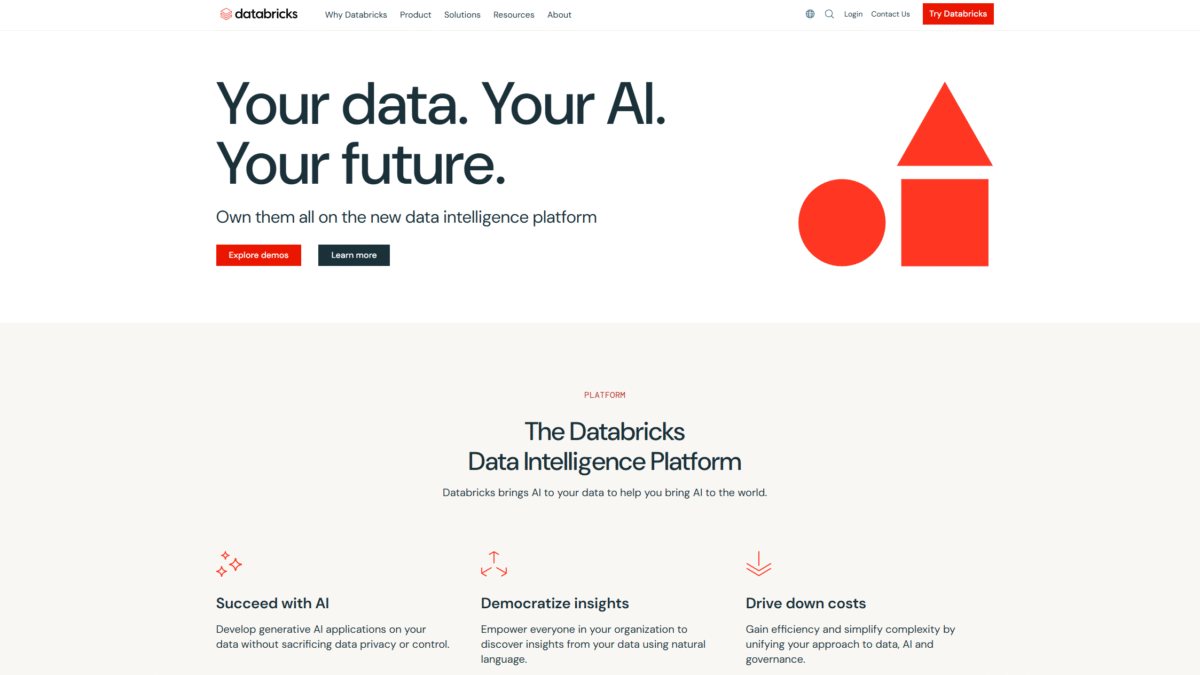

Unlock Exclusive Databricks Deal: Save Big on Data & AI
Searching for an unbeatable offer on Databricks? I’m delighted to share an exclusive opportunity that I’ve confirmed is the most generous discount circulating right now.
In the following sections, I’ll walk through why Databricks stands out as a powerhouse for data and AI, and explain how you can Try Databricks for Free Today to unlock premium features without denting your budget. Let’s dive in.
What Is Databricks?
Databricks is a leading cloud-based data intelligence platform designed for modern enterprises that demand seamless integration of data engineering, data warehousing, analytics, and machine learning. I consider it a one-stop shop for building, scaling, and governing data-driven AI solutions without sacrificing lineage, quality, control, or privacy. Whether I’m orchestrating batch ETL jobs, spinning up interactive SQL warehouses, or fine-tuning foundational AI models, Databricks provides a unified environment to streamline every step of my workflow.
At its core, Databricks transforms raw data into actionable insights and production-ready AI models. Organizations use it to:
- Ingest, process, and query petabytes of data at cloud scale.
- Develop and deploy generative AI and machine learning models.
- Collaborate across data engineers, data scientists, and business analysts.
- Maintain robust governance, security, and compliance controls.
Features
Databricks packs a comprehensive suite of features that span the entire data and AI lifecycle. Below, I break down the standout capabilities that have consistently driven value in my projects.
Unified Data Platform
This feature merges data engineering, data warehousing, and real-time analytics under a single pane of glass. I appreciate how it eliminates tool sprawl and simplifies licensing.
- Single workspace for notebooks, dashboards, and SQL analytics.
- Support for Python, Scala, R, and SQL in shared clusters.
- Fine-grained access control and audit logging for compliance.
Generative AI Model Development
Databricks accelerates generative AI workflows by providing pre-built foundations and seamless fine-tuning capabilities. I rely on it when I need to prototype language models or image generators quickly.
- Create custom pipelines to train and deploy models using popular frameworks.
- Integrated support for Anthropic and Mosaic foundation models.
- Built-in image and vector search tools powered by Shutterstock ImageAI.
Experiment Tracking and Governance
When I run dozens of model training experiments, tracking hyperparameters, metrics, and data lineage becomes essential. Databricks delivers automated experiment management with governance baked in.
- Auto-capture parameter configurations and performance metrics.
- Unified Log Store to audit every change and result.
- Role-based permissions ensure only authorized users can view or alter experiments.
Real-time Analytics and Streaming
For scenarios requiring sub-second insights—like anomaly detection or real-time personalization—Databricks’ streaming engine is a game-changer in my toolkit.
- Built on Apache Spark Structured Streaming for scalable pipelines.
- Support for Kafka, Delta Live Tables, and native connector integrations.
- Elastic scaling to handle bursts of streaming data without manual intervention.
Collaborative Workspace
Databricks fosters collaboration by bringing data engineers, data scientists, and analysts together in a unified environment. I find it incredibly valuable for cross-functional teams.
- Interactive notebooks with shared commenting and real-time co-editing.
- Dashboard creation to visualize results without leaving the platform.
- Integrated REST APIs for programmatic access and CI/CD integration.
Comprehensive Integrations
The platform plugs into my existing ecosystem—ETL tools, BI systems, data lakes, and cloud services—so I don’t have to rip and replace my established workflows.
- Native connectors for Snowflake, AWS S3, Azure Data Lake, and Google Cloud Storage.
- Pre-built integrations with Tableau, Power BI, Looker, and more.
- Support for popular orchestration tools like Airflow, Prefect, and Azure Data Factory.
Pricing
Understanding costs is crucial when adopting any enterprise platform. Databricks offers flexible pricing models to fit both lean experimentation and large-scale production deployments. I encourage exploration of details at https://go.thenerdynoob.com/databricks to choose the best fit.
- Pay as You Go: No upfront commitment and billing at per-second granularity.
- Committed Use Contracts: Discounts for committing to sustained usage levels across multiple clouds.
Data Engineering
- Starting Price: $0.15 per DBU
- Ideal for building ETL, ML pipelines, streaming, and batch processes.
- Includes autoscaling clusters and optimized runtime.
Data Warehousing
- Starting Price: $0.22 per DBU
- Designed for interactive SQL analytics, business intelligence, and dashboards.
- Enables high concurrency and low-latency query performance.
Interactive Workloads
- Starting Price: $0.40 per DBU
- Supports collaborative data science and ML applications with governance.
- Includes notebooks, jobs, and model serving.
Artificial Intelligence
- Starting Price: $0.07 per DBU
- Optimized for generative AI, large language models, and production ML apps.
- Comes with Mosaic AI Gateway and Pre-training capabilities.
Operational Database
- Starting Price: $0.40 per DBU
- Managed Postgres-compatible database for serving application data.
- Ensures predictable performance and automatic failover.
Benefits to the User (Value for Money)
I believe Databricks delivers unmatched value by combining multiple capabilities into a single platform. Here are the key benefits I’ve experienced:
- Cost Efficiency – Eliminates the need for separate licensing of disparate tools, reducing overall spend.
By paying at per-second granularity or through committed contracts, I’ve minimized idle cluster costs and gained predictable budgeting. - Accelerated Time to Insights – Rapid prototyping and interactive dashboards shrink development cycles.
My teams move from concept to production in weeks instead of months, directly impacting revenue generation. - Data Governance & Compliance – Built-in access controls, lineage tracking, and audit logs streamline regulatory compliance.
I sleep easier knowing that every data transformation and model iteration is secure and traceable. - Scalability on Demand – Elastic clusters scale up automatically during peak loads and scale down afterward.
This flexibility ensures performance consistency without overprovisioning resources. - Unified Collaboration – A shared workspace breaks down silos between engineers, analysts, and scientists.
Real-time commenting and shared notebooks keep everyone aligned on project goals and progress.
Customer Support
I’ve found Databricks’ support team remarkably responsive and knowledgeable. Whether I submit a ticket through their portal or use live chat, I usually receive acknowledgement within minutes and actionable guidance shortly thereafter. The support engineers are well-versed in cloud architectures and data workflows, which shortens resolution times.
Beyond reactive support, Databricks offers optional managed services and architecture review sessions. These engagements help me optimize cluster configurations, implement best practices for governance, and troubleshoot complex performance bottlenecks. For mission-critical applications, having direct access to expert support has been invaluable.
External Reviews and Ratings
Industry analysts and user feedback consistently praise Databricks for its robust platform and rapid innovation. On G2, it holds a 4.6-star rating out of 5, with customers highlighting its scalability and streamlined data-to-AI workflows. Gartner references Databricks as a Leader in the Data Science and Machine Learning Platforms Magic Quadrant, citing its unified architecture and strong partner ecosystem.
Some critiques focus on the learning curve for Apache Spark concepts and initial setup complexity. Databricks has responded by enhancing its onboarding experience, offering guided tutorials, and expanding documentation. The addition of Databricks Academy and structured training paths demonstrates their commitment to addressing user feedback.
Educational Resources and Community
To help me—and countless others—get up to speed, Databricks maintains a rich library of educational material. This includes:
- Official Blog: Regular articles on product updates, architecture deep dives, and customer success stories.
- Video Tutorials & Webinars: Step-by-step guides on notebooks, Delta Lake, MLflow, and advanced AI features.
- Comprehensive Documentation: Detailed API references, quickstarts, and best practice guides.
- Databricks Community Forum: An active user community for peer support, Q&A, and open-source project collaboration.
- Databricks Academy: Self-paced and instructor-led training courses, plus certification programs for both engineers and data scientists.
Conclusion
After exploring Databricks’ unified data intelligence platform—from its powerful generative AI capabilities to enterprise-grade governance and elastic scaling—it’s clear why I recommend it wholeheartedly. The exclusive offer to Try Databricks for Free Today presents the perfect opportunity to test-drive every feature risk-free. Whether I’m tackling high-volume ETL pipelines, developing production AI models, or empowering my entire team with self-service analytics, Databricks delivers unparalleled performance and value.
Ready to elevate your data and AI strategy? Claim your portal access now by visiting https://go.thenerdynoob.com/databricks and Try Databricks for Free Today.
